Advancing Energy Security and Economic Continuity
Johannesburg, 1 April – Seriti Green yesterday announced a further R10 billion investment into renewable energy infrastructure in Mpumalanga at the 6th South Africa Investment Conference (SAIC 2026), bringing its total committed and deployed investment in the province to R25 billion.
Held at the Sandton Convention Centre, SAIC 2026 has positioned itself as a platform focused on converting reform momentum into capital deployment, strategic partnerships, and measurable economic outcomes. The emphasis has shifted towards projects that are already underway and investments that demonstrate tangible delivery.
In his closing address, President Ramaphosa shared, “This conference has demonstrated that our economy is entering a new phase of growth. When a country becomes more attractive and starts blooming like a flower, it attracts the bees.”
Seriti Green’s announcement reflects this shift. The investment builds on the company’s earlier participation in the national investment drive. At a previous conference, Seriti Green committed R5 billion and received recognition for its contribution to advancing the Just Energy Transition. Since then, the company has deployed R15 billion into projects across Mpumalanga, moving from commitment to execution.
The additional R10 billion will be directed towards expanding wind energy capacity and supporting infrastructure. This strengthens Mpumalanga’s role in South Africa’s evolving energy system and reinforces the province’s position as a centre of both existing and future energy production.
The scale of the investment makes it one of the largest infrastructure programmes undertaken in Mpumalanga. It is expected to support economic activity across construction, logistics, and local supply chains, while contributing additional generation capacity to the national grid.
Seriti Green’s projects are located within South Africa’s coal heartland. This allows for a practical and measured approach to the energy transition, where renewable energy is developed alongside existing coal operations. Both energy sources remain important in supporting the country’s current and future
needs.
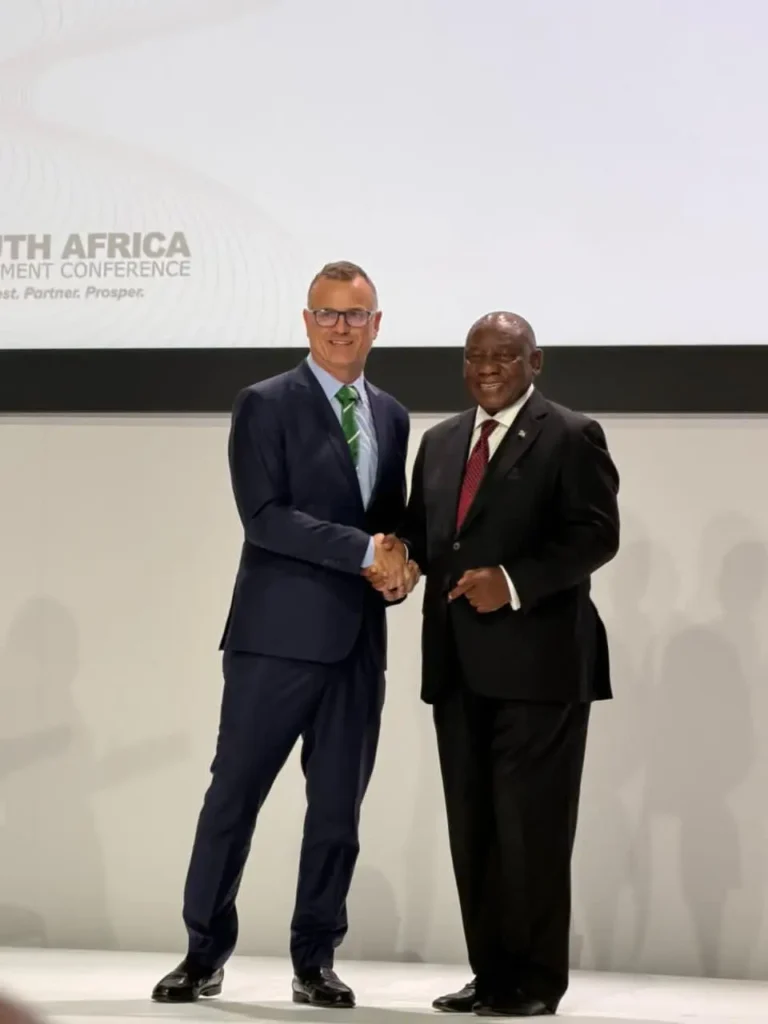
Mike Teke, GCEO of Seriti Resources, highlighted that the Just Energy Transition must translate into real benefits for people on the ground. “Standing alongside the President at this year’s Investment Conference reinforced that the transition must be tangible for communities. In Mpumalanga, where livelihoods have long depended on coal, new investment must create jobs, support local businesses, and provide a clear pathway for economic continuity. What we are seeing is that this transition can be managed in a way that protects communities while building new industries alongside existing ones.”
South Africa’s energy system remains heavily dependent on coal, with a significant portion of employment and regional economies linked to the sector. In this context, the transition requires careful management to ensure that new investment supports job creation and economic continuity.
Seriti Green has placed a strong emphasis on local participation. The company has engaged extensively with communities in Mpumalanga, registering more than 18,000 job seekers and prioritising local employment and procurement. Skills development programmes are also being implemented to support the movement of workers into new areas of the energy sector.
This reflects a broader view of the Just Energy Transition as a process that must support economic growth while reducing emissions. Investment in infrastructure, skills, and communities forms a central part of that approach.
The focus on delivery was also reflected in Seriti Green’s approach to investment and project execution.
Peter Venn, CEO of Seriti Green, said the conference highlighted the importance of delivery. “There is a clear shift towards execution. Investors and government alike are focused on projects that are being built, not just announced. Our investment in Mpumalanga reflects that. We have moved from a R5 billion commitment to R15 billion deployed, and we are now committing a further R10 billion.”
The development of wind energy projects in Mpumalanga contributes to improving energy security. Additional generation capacity supports the national grid and reduces pressure on existing infrastructure, particularly during periods of high demand.
Seriti Green’s work in Mpumalanga forms part of a broader strategy to build a diversified energy portfolio. The company continues to explore further opportunities for renewable energy development in partnership with the government, financial institutions, and local stakeholders.
Venn added that sustained investment will be key to long-term growth. “If we want to see meaningful economic progress, we need to see continued investment in infrastructure and construction. For us, deploying capital in Mpumalanga is a privilege and delivering the Just Energy Transition for the people of South Africa is at the centre of what we do and will do for decades to come.”
For more information, please contact:
Seriti Green:
info@seritigreen.com
+27 11 047 7000